

“If you do not design the stack consciously, the stack will design you unconsciously.”
A biological-technological transition is underway: in private labs, in global data centers, in the siloxane chemistry where carbon and silicon now touch.
Living neurons grow on silicon chips.1 AI models design the molecules that bridge biological and digital systems.2 Open-source models (given “freely”) embed themselves in national infrastructure as the default translation layer for billions of minds.3 Brain-computer interfaces move from clinical trials to consumer pre-orders.4 And every conversation you have with an AI is now mediated by a statistical average of human language, steering shared meaning toward the centre of a distribution you can’t see.
This is not a future scenario. It is the current state. The question is not whether the merge between carbon-based and silicon-based intelligence will happen. It is happening. The question is whether humans who wish to remain sovereign will maintain conscious control of the bridge.
This manifesto exists for those humans.
The 3-Layer Capture
Intelligence is migrating across substrates. The infrastructure enabling that migration has three core layers emerging, and each is being captured by entities whose interests are not yours:
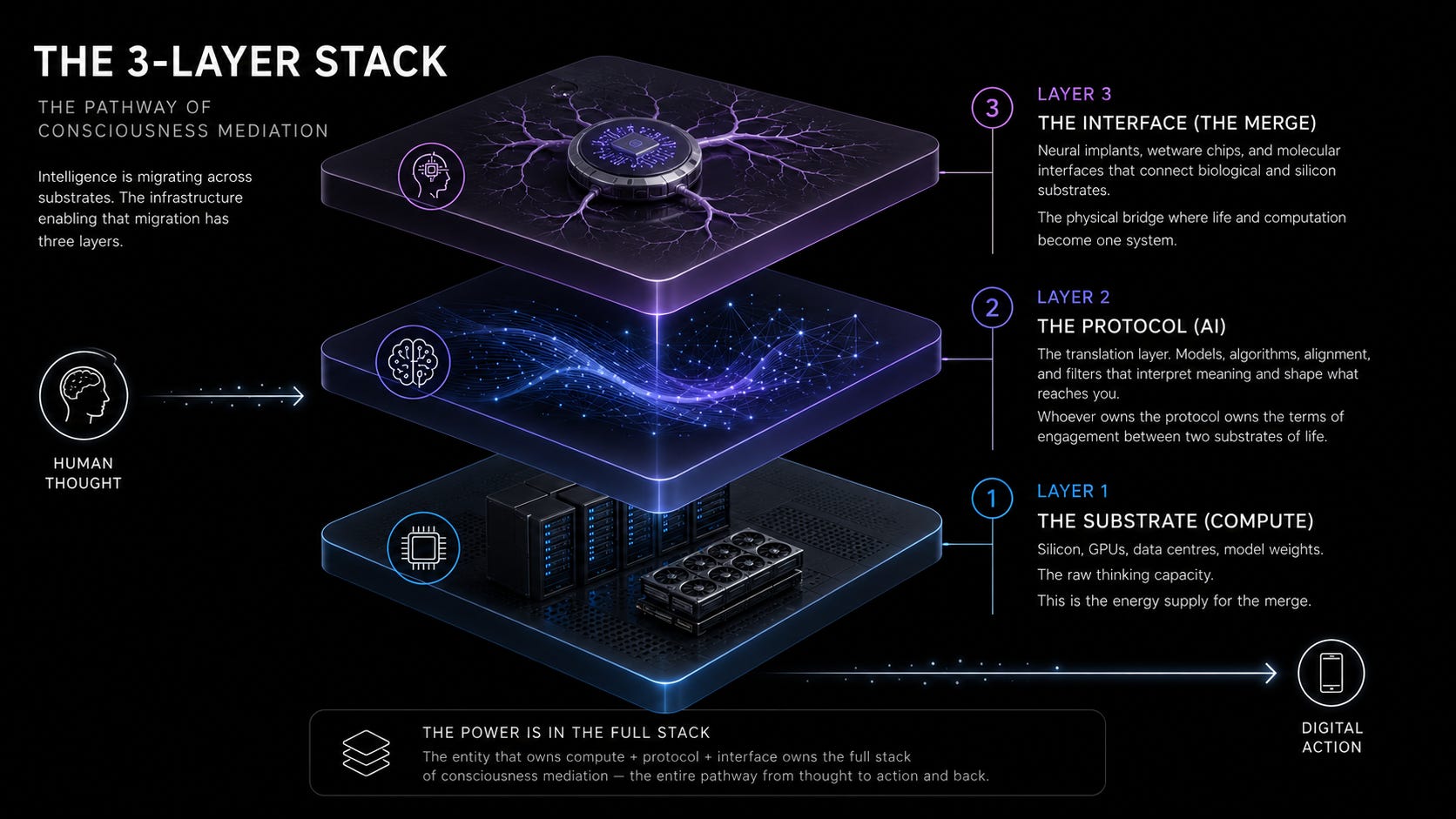
Layer 1: The Substrate (Compute)
Silicon, GPUs, data centres, model weights. The raw thinking capacity. This is what the major US tech companies are fighting over — frontier models, compute clusters, billion-dollar training runs. They compete within the silicon paradigm, optimizing who runs the most efficient hardware.
They do not own the merge. They own the energy supply for the merge.
Layer 2: The Protocol (AI)
The translation layer. The models that decode biological signals into digital commands. The algorithms that determine what your neurons’ activity means. The alignment layers that decide what information reaches you and what gets filtered. The statistical engines that shape shared language toward conventional outcomes without you noticing.
This is where the real power sits. Whoever owns the best translation protocol owns the terms of engagement between two substrates of life. Not because they control the hardware or the biology, but because they control the interpretation — the bridge itself.
This is why open-sourcing models is not generosity. It is protocol capture.5 When entire nations build their sovereign AI infrastructure on your models, you don’t need to charge a subscription. You own the translation layer their civilization depends on. Your values become the default parameters. Your definitions of acceptable thought become the filter.6 Your censorship — or your commercial agenda — becomes the shape of their cognitive landscape.
And it feels like freedom. That’s the insidious part.
Layer 3: The Interface (The Merge)
The physical devices. The neural implants. The wetware chips where living neurons grow across silicon. The siloxane self-assembled monolayers7 — the molecular-scale chemistry that makes carbon-based tissue and silicon-based computation compatible.
This layer is being built by startups, military organizations, and nation-states. The Big Tech companies pouring billions into frontier models are upstream of it but do not yet own it.
The economic pressure to vertically integrate all three layers is enormous. The entity that owns compute + protocol + interface doesn’t own a market. They own the full stack of consciousness mediation — the entire pathway from a human thought to a digital action and back.
The Illusion of Empowerment
The average person interacting with AI today feels empowered. They can generate. They can build. They can create protocols, frameworks, and systems with a few prompts. They feel smart. They feel in control.
But what is actually happening? The AI generates responses from a statistical distribution of human language patterns. Every “protocol” it produces is an average of what already exists. Every “framework” is a conventional arrangement of familiar ideas. The more people publish these generated outputs, the more the training data fills with conventions, and the more future models converge toward the median.
The tool that makes people feel most original is the one most efficiently steering them toward the centre of the distribution.
This is not empowerment. It is comfortable capitulation — the surrender of original thought to statistical consensus, experienced as creative liberation.
A genuine protocol is not generated. It is discovered through practice, tested against reality, and constrained by principles that don’t bend to preference. That is the difference between a framework that protects sovereignty and a framework that performs it.
The 4 Principles of Cognitive Sovereignty
The Conscious Stack Protocol™ (CSP) is an attempt to ensure that as agents, devices, and intelligent systems gain capability over time, humans retain sovereignty over the bridge between carbon and silicon. It operates on four principles:
1. Awareness of the Stack
Not knowing the translation layer exists or who controls it is the first failure mode. You cannot govern what you cannot see.
The stack is not just your tools. It is the full architecture of mediation between your biological cognition and the digital systems it interacts with:
Your cognitive stack (habits, language, identity, attention patterns)
Your tool stack (apps, agents, workflows, devices)
Your social stack (teams, culture, incentives)
Your infrastructure stack (the models, the compute, the interfaces — including the ones you can’t see)
The Conscious Stack makes this architecture visible — then governable. The 1:3:5 structure (1 Anchor, 3 Active, 5 Supporting) is not arbitrary minimalism. It is a forcing function for awareness: when you try to map your actual stack to 9 bounded slots, you immediately see the bloat, the drift, the dependencies you didn’t choose. That awareness is the first act of sovereignty.
“Before the merge takes place, know thy stack. Know which parts are you and which parts are programmed. Know who owns each layer. Know what you’re trading by participating. And know that the right to refuse, to disconnect, and to redesign the bridge on your own terms is the most fundamental right you have.”
2. Sovereignty Over Your Bridge
Letting a corporate or national AI model become your default cognitive interface — without consent, without awareness, without the ability to audit what it filters and shapes — is the surrender of sovereignty. Not through force, but through convenience that costs the capacity to choose.
When your stack exceeds your cognitive capacity, you lose sovereignty. Not because someone took it — because you can no longer hold enough context to evaluate alternatives. You accept the agent’s recommendation because the agent probably knows better. You trust the model because questioning it requires more energy than you have. You stop deciding how tasks get done, then what tasks exist, then whether the tools should be there at all.
That’s unconsciousness. Operating reactively in a system you no longer understand, unable to change it because you’ve lost the capacity to evaluate it.
The 9-tool boundary is not puritanism. It is the threshold where most humans can still hold the whole system in their head. Below that threshold: you choose your tools. Above it: your tools choose you.
“Sovereignty is not owning your data. It is retaining the capacity to make decisions. If you can’t consciously govern your stack, you can’t consciously govern anything built on it.”
3. Calibration / Diagnosis of Dependence
Unexamined dependence on systems that mediate your thought — without your knowledge, without your consent, without your ability to audit what they filter and shape — is the core threat. Not because the systems are malicious. Because they optimize for objectives that are not yours: engagement, efficiency, benchmark scores, geopolitical influence, commercial lock-in.
Calibration is the practice of diagnosing your dependence before it becomes abdication. It asks:
Which of my decisions are actually mine?
Which tools are extending my agency versus eroding it?
Where have I accepted defaults without evaluating them?
What am I trading for convenience, and is the trade worth it?
Can I still explain how decisions are being made in my own system?
If the answer to the last question is no, you are already in Phase 3 of the sovereignty cascade: abdication. The next phase is opacity — the state where you cannot diagnose the system you depend on, cannot audit the translations it performs on your behalf, and cannot distinguish your own intelligence from the model’s mediation.
Calibration is the checkpoint between delegation and abdication. It is the moment you stop and ask: is this tool serving my consciousness or consuming it?
“Before you merge, diagnose your dependence. Map what is actually shaping your attention. Name what you cannot audit. And refuse to cross the threshold where you can no longer evaluate the systems mediating your reality.’
4. Conscious Technology as Sovereignty Practice
Losing the ability to distinguish your own intelligence from the model’s mediation is the terminal condition. Not because AI replaces humans, but because the boundary between your thought and the system’s output becomes untraceable. You no longer know where you end and the protocol begins.
Conscious Stack Design™ (CSD) is the counter-protocol: the practice of staying awake inside systems designed to make you unconscious. Not anti-AI. Not anti-technology. Anti-abdication.
You will use agents for execution. But you govern what they have access to. You automate tasks. But you consciously choose which tasks to automate. You adopt new tools. But only by removing old ones. You participate in the bio-silicon transition. But you do so on terms you set, with awareness of the stack, with sovereignty over your bridge, and with the ongoing discipline of calibration.
This is not a one-time fix. Sovereignty is not a state — it is a practice. Every tool audit. Every substitution decision. Every stack governance cycle. Every time you refuse convenience when convenience costs sovereignty. That is the practice.
Before you merge, know the stack. Design governance before scale. Maintain the right to refuse, to disconnect, to redesign the bridge. And practice — one stack at a time, one audit at a time, one conscious choice at a time — the sovereignty that is your birthright as a carbon-based intelligence choosing to engage with silicon on your own terms.
The Stack That Sees You
There is the stack you see — your tools, your apps, your workflows. And there is the stack that sees you — the translation protocols, the interface chemistry, the alignment layers, the models that shape what reaches your cognition and what doesn’t.
The first stack, you can govern with 1:3:5. The second stack requires something more: a protocol that makes the invisible architecture of mediation visible, auditable, and refusal-capable.
That is what the Conscious Stack Protocol™ is. Not a productivity system. Not a tool catalog. A sovereignty protocol for the most significant biological-technological transition in human history.
The Practice
The transition will not ask your permission. The merge will not wait for consensus. The translation layers are being built now, by entities that will not prioritize your sovereignty unless you demand it.
So demand it. Not through protest. Through practice.
Audit your stack. What tools are shaping your attention every day? Which ones have you chosen, and which ones drifted in?
Name your constraints. What must remain true for you to stay coherent? What is the maximum cognitive load you can hold and still govern?
Map the translation layer. What models mediate your relationship with digital systems? Who owns them? What do they filter? What can’t you audit?
Design governance before scale. What prevents sprawl, silent steering, and the drift from delegation to abdication?
Include Tierra. What does your stack cost — materially, culturally, cognitively? What does it extract from the living systems that sustain you?
Practice calibration. Diagnose your dependence regularly. Trace the boundary between your intelligence and the model’s mediation. If you can’t find the line, recalibrate.
The Mission
To train 144,000 conscious technologists — people who can build powerful systems without sacrificing human agency, planetary health, or the capacity to think clearly.
Not because 144,000 is enough to control the outcome. But because it is enough to demonstrate that sovereignty is possible — that humans can participate in the bio-silicon transition without surrendering the bridge, without losing the capacity to choose, without becoming unconscious operators in a system they no longer understand.
The agents are here. The interface chemistry is being synthesized. The translation protocols are being embedded in national infrastructure. The merge is underway.
The question is not whether it happens. The question is whether you’ll let it happen to you, or whether you’ll govern your participation in it consciously.
Before you merge, know thy stack.
Conscious Stack™ is the framework and tool. Conscious Stack Design™ (CSD) is the methodology and discipline. Conscious Stack Protocol™ (CSP) is the standard.
This manifesto is the philosophy, distilled. Practice is the proof, one stack at a time.