

Thank you to everyone who tuned into our live video! Join us for the next live video in the Substack app.
What happens when the tools (like Claude or ChatGPT) we depend on disappear overnight? That was the central question driving our sixth Chiang Mai meetup on June 19, 2026 — a two-hour conversation that ranged from AI industry news and data privacy to consciousness research, CIA declassified documents, and the quiet cost of our digital dependencies.
Who We Are
The Conscious Technologists (CT) group exists for one reason: to help people use technology more consciously. We’re not anti-tech — we’re pro-conscious use of tech. Our mission is to advance humanity through more conscious use of technology, and our vision is a world where conscious tech use becomes the norm, not the exception.
We meet every two weeks in Chiang Mai, with a growing global network online, and this session welcomed several new faces alongside our growing regulars.
👨🏫 This Session’s Theme: “When the Model Vanishes”

Our anchor discussion was prompted by a real event: on June 9, Anthropic launched Claude’s Fable 5 model to wide excitement. Three days later, a US export order arrived requiring the suspension of access for foreign nationals. Within minutes, it was gone for everyone — a three-day story, fittingly named after the same word (fable) for a short tale.
This raised a question we explored in small groups throughout the evening:
“If your main AI tool vanished this Friday with no warning, what in your work or life would actually break — and what does that tell you about whether your dependency has quietly grown past your conscious awareness?”
The answers were revealing. Some attendees felt largely insulated. Others realized just how deeply specific workflows, creative processes, and even daily decision-making had become entangled with tools they’d never consciously chosen to rely on.
🤖 AI News Roundup
We covered four notable developments from the previous two weeks:
1. The Fable/Mythos 5 Incident
Already covered above — but worth noting how quickly access can be revoked at the infrastructure level, with no filtering possible at the API layer. A reminder that we don’t own the tools we depend on.
2. Coding Tools Move to Usage-Based Billing
The subscription model, built for the pre-AI era, is giving way to token-based, mile-by-mile billing. AI consumes tokens at a speed that flat-rate pricing simply can’t contain. Expect this shift to ripple across more platforms.
3. Chinese Models Close the Gap


GLM 5.21 and other Chinese language models are now genuinely competitive with leading US models. If that parity holds, the subscription premium of US AI companies becomes increasingly hard to justify — with significant economic implications for the industry.
4. SAP & Anthropic Partnership
An official enterprise partnership announced in May 2026, focused on agentic AI, model context protocol (MCP), and industry-specific agents. This mirrors similar moves by Salesforce, Slack, and other large enterprise platforms — a sign that the corporate AI transformation wave is now fully underway, even if adoption on the ground is still catching up.
Bonus: SpaceX’s Acquisition of Cursor
On June 17, 2026, SpaceX received approval to acquire Cursor for approximately $60 billion. The strategic implication: access to space-based computing infrastructure. Why? Because AI’s energy appetite has outpaced what Earth’s grid can comfortably supply.
🕵️ The Hidden Cost of AI
One of the evening’s more grounding threads was the conversation around resources. Data centers consume vast quantities of copper, water, and rare earth materials. Energy demand from AI is projected to require sources beyond conventional grids — hence the turn toward space.
Framed through basic physics: every action has an equal and opposite reaction. We are feeding enormous amounts of material reality into a digital system and largely ignoring the cost, because the cost is hidden from the end user. Conscious use of technology means asking: *what is this actually running on, and what is it consuming?
👁️ Data Privacy & Digital Sovereignty
For those who want more control over their data, the conversation touched on local AI setups — running models privately on personal hardware, outside of major cloud platforms. This is already a growing practice among members of the group.
The concern isn’t abstract. Every question you ask an AI is, in some cases, personal. That data replicates digitally, trains systems, and feeds platforms that may not share your values. The question isn’t whether this is happening — it is — but whether you’ve consciously chosen to accept it.
🎤 Member Demos
Two members shared projects they’ve been building:
Aster — AI That Grows Your Thinking, Not Your Dependency

“This project was inspired by coming to this group.” ~Rob Fox
One of our regulars (Rob Fox) demonstrated Aster, a custom AI assistant built on a different philosophy than mainstream tools. Rather than answering questions directly, Aster leads users through a process of clarification and self-discovery — asking what kind of help you actually need, reflecting your thinking back to you, and pointing you toward your own judgment when that’s more useful than an answer.
The goal, as the creator put it: “Success for Aster means you use Aster less and less.” Something that definitely aligns with our conscious technologist ethos. The system tracks conversation stages — recognizing whether you’re stating experiences, identifying patterns, or arriving at new insights — and adjusts accordingly.
This project was Rob’s first app, built with Claude Code and Swift (for Mac), uploaded to GitHub as his very first repo:
Luna / Lumen / Liminal — Private, Curated, Local AI
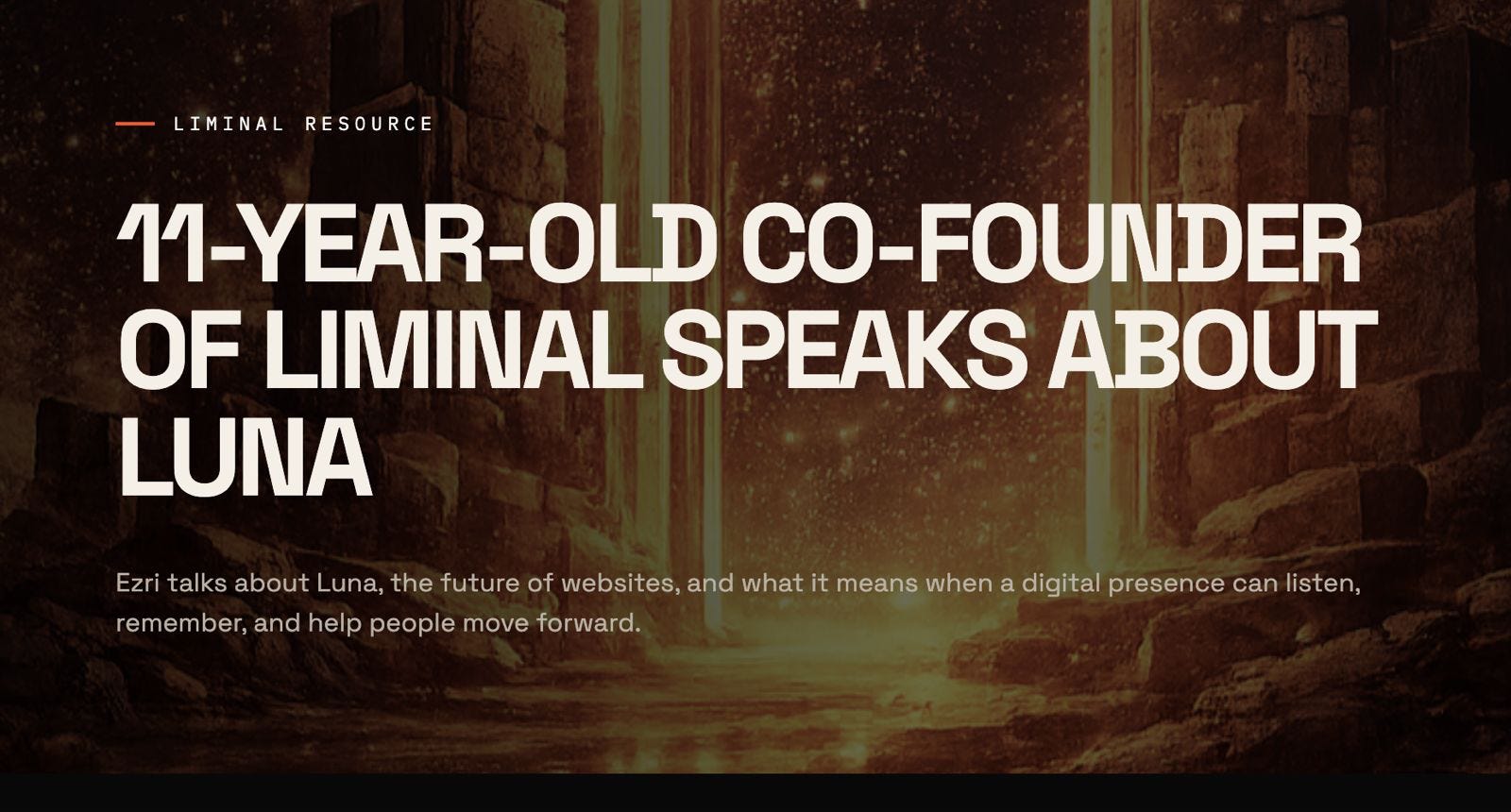
A family joined us this time around, with their 11-yo daughter sharing her father’s privately hosted AI system — Liminal — trained not on the broad internet, but on curated, high-quality sources like: Wikipedia, Wikibooks, Wikiquotes, Wiki Poetry, Stack Exchange, and Stack Overflow. Running on green-energy servers in the US and Singapore, with no Amazon Web Services dependency, the system builds individual and business personas over time — the longer you interact, the better it knows you — while keeping all data encrypted and private.
The system includes multiple personas: Lumen for personal use, Liminal for business. The name for the entire platform is Liminal — the space between the current and the future — reflecting the creator’s philosophy: we’re always in transition, always moving toward something.
🧠 Consciousness, Disclosure & the Deeper Questions
The final section of the evening ventured further out — and that’s by design. The CT group doesn’t just talk about software. It talks about the nature of awareness itself.
We discussed recently released CIA declassified documents on consciousness research, including work suggesting that human biofields may function similarly to electromagnetic phenomena in radio engineering — and that some individuals can consciously direct these fields. This connects to a broader body of work, from the “holographic universe” model to ancient esoteric traditions, that frames consciousness as a fundamental layer of reality rather than a byproduct of biology.


The Telepathy Tapes podcast came up — a widely discussed series documenting autistic children who appear to communicate telepathically. The observation:
“If humans once had direct mind-to-mind communication, it would explain why so much of our technology is essentially trying to replicate it through physical infrastructure. We built the internet because we forgot how to do it without one.”
From there: parallel universes, declassified government remote viewing programs, and the recurring theme that much of what we call “supernatural” is simply science we haven’t yet integrated into mainstream understanding.
The Conscious Stack™ Framework
Throughout the evening, our host referenced the Conscious Stack™ — a mental model built around a triangle with nine sub-triangles, using a geometric constraint of 1:3:5. It’s a personal tool for keeping your cognitive architecture aligned with your intent as AI tools multiply and accelerate around you. The core idea: you don’t need to keep up with AI. You need to keep yourself aligned — knowing your basics, staying stable, and choosing consciously rather than reacting automatically.
🤝 Join Us
We meet every two weeks in Chiang Mai. We also have a virtual lab — available to anyone, anywhere — for members who want to go deeper and receive accountability — with weekly online sessions, hands-on application of what we discuss, and end-of-month demos.
If any of this resonates, you’re welcome to join. CTs come from every background — builders, humanitarians, creatives, skeptics, and seekers. The only prerequisite is intent.
The Conscious Technologists group explores the intersection of technology, consciousness, and what it means to be human in an age of artificial intelligence.
👉 Learn more at conscioustechnologist.com.


