
Second Meetup, AI Brain Fry & the 5 CT Types
A review of Mar 17-24 Apr, 2026

Welcome back to Conscious Stacks,
This was a week where things started materializing. The WhatsApp group has been alive with discussions on sovereign AI setups, perception hygiene, and what happens when your tools start thinking faster than you do.
The second in-person meetup happened Thursday evening in Chiang Mai, Thailand — more on that below. New community applications are rolling in through consciousstack.com/community, the Stack Assessment quiz is producing real self-identification (Catalysts, Nomads, Architects), and the CT Lab on Skool is being built out with members.
The movement is no longer conceptual. Here’s the signals since we last spoke.
George Siosi Samuels
Founder
🤔 3 Themes That Keep Surfacing
1. Sovereign AI & the Personal Operating System
The shift from centralized AI dependency toward private, local AI ecosystems continues to dominate. Members are actively building what they call a “Personal OS” or “harness” using open-source models and frameworks. The driver isn’t paranoia but agency. CSD’s 1:3:5 rule and the 9-slot pyramid give structure to an otherwise overwhelming landscape of tools.
2. Cognitive Sovereignty & Perception Hygiene
How does rapid AI integration rewire the brain? The group referred to “cognitive collapse” for what happens when humans outsource too much thinking to machines — mental models atrophy, decision-making weakens.
Inka Linda mentioned “perception hygiene”: treating your AI environment like an ecological system that shapes attention, imagination, and the nervous system.
Darren flagged sycophantic AI — models designed to agree with you — as a subtle form of manipulation that erodes real-world conflict skills. Maarten kept grounding it in his evolutionary mismatch theory: our biology is misfiring because modern tech exploits survival mechanisms.
3. The Irreplaceability of Human Connection
As AI commoditizes intelligence and technical execution, genuine human relationships and embodiment become the scarcest resource. AI can simulate empathy; it cannot co-regulate a nervous system. This conviction shows up in what members are building: Darren’s HeartSpace (AI-guided couples’ intimacy), Nida’s IRL relationship OS, and the community’s insistence on frequent in-person meetups. The thesis: connection is infrastructure, not an add-on.
📰 News/updates
1. “AI Brain Fry” Goes Mainstream
Research from BCG and HBR confirmed what the group has been feeling: cognitive fatigue and mental fog from using multiple AI systems simultaneously. Workers report feeling “dumber” after heavy AI sessions. The community’s term — “cognitive collapse” — predates the research. At Thursday’s meetup, this became the anchor for why Conscious Stack Design™ exists: your stack is a health issue, not just a productivity choice.
2. The Conscious Technologist Types
Unveiled at the meetup: a framework for self-identification within the movement.
Six archetypes emerged from community patterns — Stack Architect (systems builder), Cognitive Guardian (attention protector), Governance Weaver (policy + ethics), Wisdom Bridger (ancient wisdom + tech), Sovereign Builder (local-first infrastructure), and Culture Coder (narrative + community). Attendees immediately started mapping themselves. It’s not final, because we’re still testing the data, but it’s a start!
3. Stack Builder Adoption & Creative Use
The Stack Builder tool — a visual way to design your 1:3:5 using the Conscious Stack Pyramid — is being used in ways that surprised even me. Freeman and Jazmine shared how they’ve adapted the pyramid for their own workflows, prompting a live moment at the meetup where both demonstrated their setups. The tool moved from “concept demo” to “practitioner instrument” this week.
👀 Misconceptions
Three Things People Get Wrong About AI Sovereignty & Stack Design
“Sovereignty means going off-grid.”
Multiple members surfaced this assumption. But sovereign AI isn’t about disconnecting — it’s about choosing your dependencies consciously. Nothing connected to the internet is 100% safe. CSD is calculated risk mitigation: you reduce vendor lock-in, run local models where it matters, and accept trade-offs with eyes open. Going fully off-grid is a lifestyle choice, not a stack design principle.
“Stack design is just digital minimalism.”
The 1:3:5 rule looks minimalist, but its purpose isn’t fewer tools — it’s cognitive coherence. A Conscious Stack might include 9 tools and an AI harness. The constraint is architectural (how tools relate to each other and to your cognition), not numerical. Minimalism optimizes for less. CSD optimizes for alignment between your tools and your nervous system.
“AI alignment is a policy problem, not a personal one.”
Governance matters — but waiting for policy won’t protect your cognition today. The group’s position: alignment starts at the individual stack level. How you configure your AI, what you delegate vs. retain, how you notice when a sycophantic model is flattering you into passivity — these are personal sovereignty decisions. Policy catches up later. Your stack is the first line of defense.
🏆 Wins & Breakthroughs
New CT Lab on Skool
We have a new home for members launching soon, the Conscious Tech Lab — an online learning lab — which is being built on Skool. Courses specific to Conscious Technologists are being uploaded, with content already spanning topics specific to members: Notion AI, Personal AI Harnesses, Stack Reviews, and even Conscious Finance. Community members are already engaging in the Skool feed.
Stack Assessment Quiz Driving Self-Identification
Multiple quiz completions this week, with people organically identifying as Catalysts (Creative Synthesizers) and Nomads (Fluid Operators). Two new community applications came in today alone — one from Sarka and one from Kyle at Tune Health. The quiz is becoming the primary top-of-funnel for the movement.
🎙️ HOTSU Podcast Pipeline Expanding
The “How Our Tools Shape Us” (HOTSU) podcast — where we unpack how founders/leaders’ tech stacks shape execution — recorded with Swati Rai (Growthful, ex-Meta/Google/Alibaba) on Wednesday. And Julien Gadea shared with members only for now previously!
New guests coming soon include: Seth Levine, Romella Janene, John Linss, Wim Roosens, Emanuele Pizzatti, and Andy McLoughlin (Uncork Capital). If you’d like to be interviewed, or even sponsor, get in touch!
🔎 Friday meetup insights
Session #2: Alt_PingRiver, Chiang Mai — April 23
Our second Conscious Technologists Unite meetup opened with a warm-up question:
“What’s one tool you’ve added or dropped since we last met?”
The answers set the tone — people aren’t just consuming AI news, they’re actively reshaping their digital environments.
The session moved through three layers. First, the news roundup anchored on “AI Brain Fry” — BCG and HBR research confirming what our community has been expecting to accelerate due to AI: cognitive collapse. The room nodded. People are feeling it in their work settings.
Then came our framework. Conscious Stack Design™ + emerging pillars — attention sovereignty, the 1:3:5 Rule, and keeping Humans-In-The-Loop (HITL) — which were presented as applied architecture, not just theory.
Our Stack Builder demo prompted a spontaneous moment: Freeman and Jazmine shared how they’d been using the pyramid in unexpected ways. Practitioner testimony hit harder than any slide.
“The reason we meet in person isn’t nostalgia. It’s strategy and relevance to the times. As AI commoditizes intelligence, the thing that becomes most valuable is what AI literally cannot do — meet physically in-person, co-regulate a nervous system, build relational trust.”
The six Conscious Technologist archetypes were unveiled for the first time (to see what resonated vs not). Breakout clusters formed around them — participants self-sorted, debated, and reported back. The question that hung in the air afterward:
“Which type of Conscious Technologist am I — and does that change how I design my personal stack?”
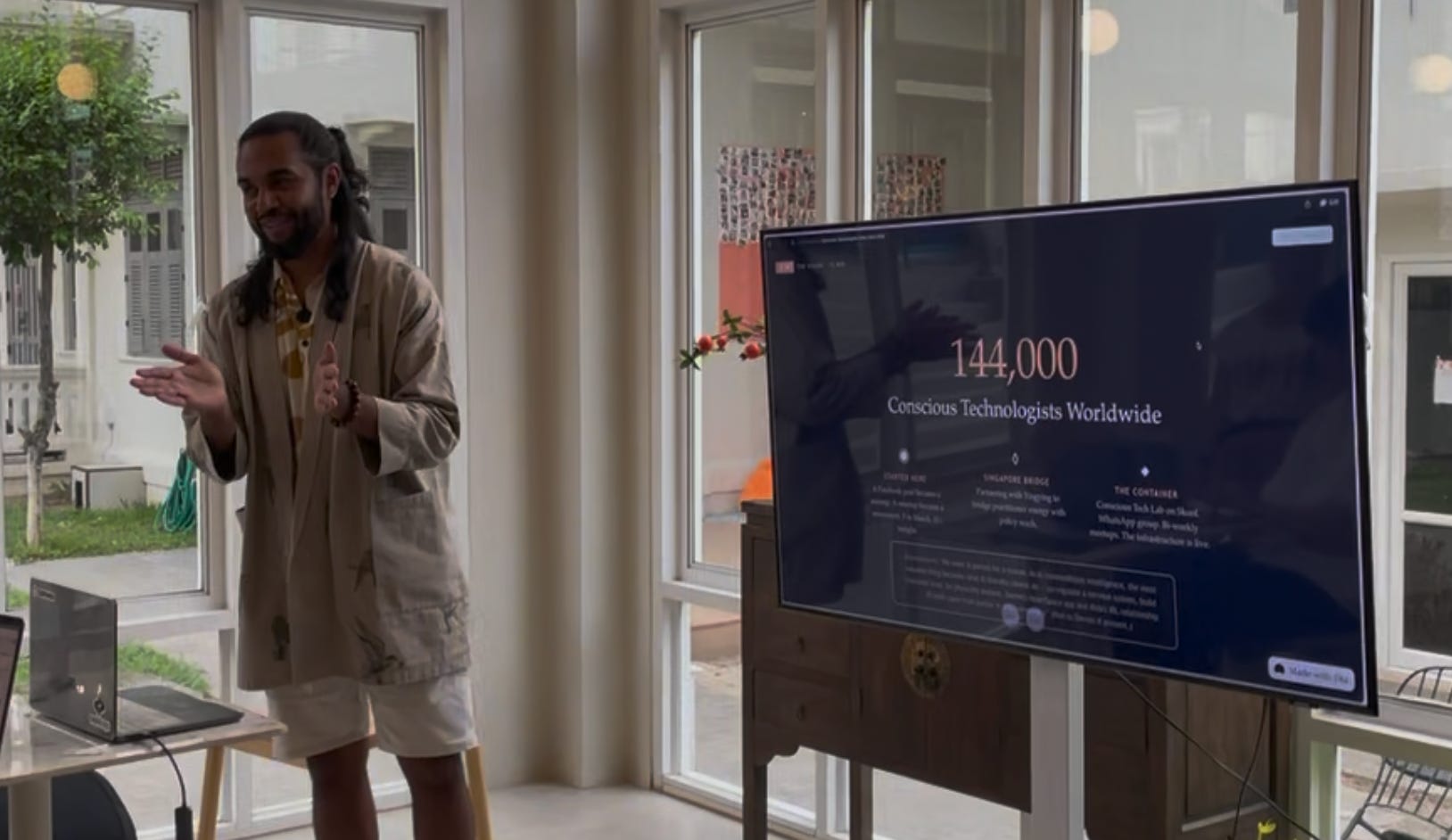
The session closed with our vision for 144,000 global community of conscious technologists, with Chiang Mai forming as first base, Singapore as a potential next bridge, and more to come. The next meetup (virtual, for our international subscribers) is already on the Luma calendar.
🔖 Links & resources
Tools
Stack Builder — design your conscious stack pyramid, based on the 1:3:5 rule, visually
Stack Assessment — go deeper into your “Stack Type/Profile”
Okara — use multiple latest LLMs for one subscription + dedicated AI CMO, offline encrypted open-source models
Dia Browser — AI-native browser with memory and briefs
Pingala Handshake Protocol - a way to apply the 1:3:5 rule to your own AI harness or chats
Member Projects & Content
“Decoding Google Veo 2” — Siosi’s latest Substack on Gemini as OS
Callie’s Substack — conscious tech brand marketing
De-Mismatch — Maarten’s evolutionary mismatch framework
Triall.ai — Maarten’s clinical trial platform
Relayn — Aleksandra’s headless, deterministic AI assistant
Play Into Being & Umaversity — community member ventures
Research & Literature
Sycophantic AI models — arXiv paper on AI agreement bias
“Our Emerging Planetary Nervous System” — Noema Magazine
“When AI Systems Talk Amongst Themselves” — Psychology Today
Spatial Intelligence — Fei-Fei Li on the next AI frontier
Enjoyed this wrap up? Join our community or subscribe to our newsletter below: